Why I Am Building Refara
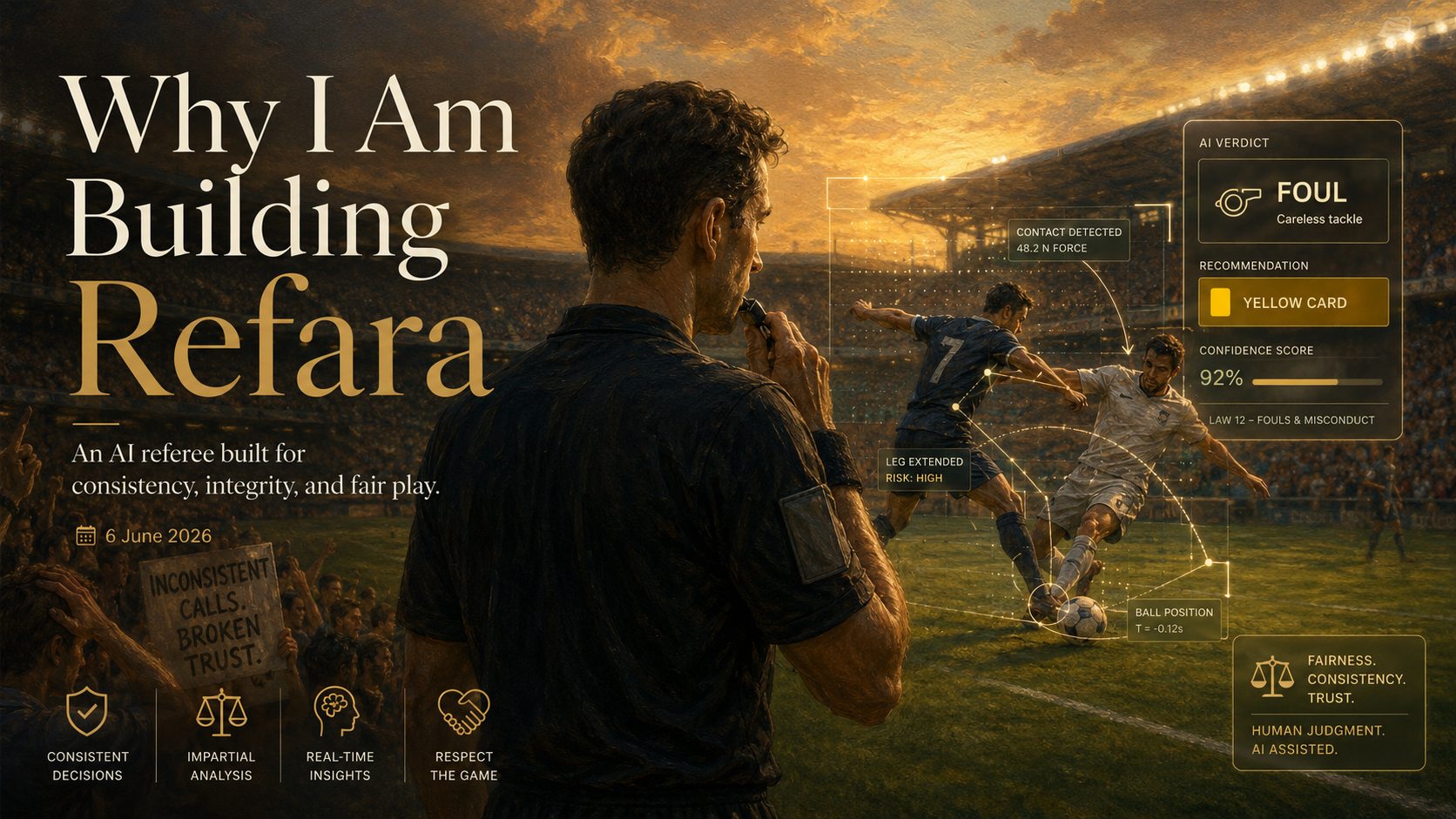
Eduardo Camavinga's red card, Joel Embiid's flopping, and Arsenal's dodgy VAR decisions. That's why I'm building my Refara AI referee computer vision startup.
I recently networked with a Solutions Architect at an AI company (feel free to guess, but I'm not listing my sources lil bro), and I learned some valuable insights on what they look for in a new grad. Luckily for you, I'm sharing the method for free. I know I am an amazing human being fr.
The conversation highlighted that the most important part about showcasing any startup or project to your recruiter is impact. The why and the stakeholders involved.
Why?
Sometimes people make amazing tools. They make projects that a) work and b) can impact a few people's lives. However, only 20 people are going to use this on a daily basis, or maybe 200. The point is, why should someone use your product? It doesn't have to be a competitive answer like our product is better than our competitors or our product can do X new thing that no one else has ever done.
Even if your product is a unique standout, that doesn't solve the why. Because yeah, maybe it saves 20% of the customer's time or it has a better UI. Those things can help make your pitch, but it won't necessarily be used.
Here's my reason for Refara. Growing up, I watched soccer, mostly Manchester City games.
The referees are the most inconsistent people on the planet. They constantly make decisions that either a) contradict themselves in a later game or b) are wrong in the moment and mess up a team's chances of winning a game honorably.
Even with VAR and technology to help detect offsides and goal-line decisions, the referees don't always make the correct decision because it's a hard job. Introducing Refara, this AI-assisted tool will make decisions based on a consistent, pre-hard-coded rule set approved by UEFA and other major soccer standards. By analyzing thousands of clips, a model is trained, evaluated, and tested to make sure the results are consistent. The main goal of Refara is to remove another VAR human element. Refara is an AI. The most important part about making a game-changing decision is the justification. Refara analyzes the clips and then gives a description of what happened in the clip, what penalty it is (red card, yellow card, free kick, offside, penalty), and the human referee makes the final call.
However, how will this impact the game, and who benefits?
Stakeholders
When you make a company, who is actually using the product? What other companies are impacted by it in a negative or positive manner? That is the next point I learned from my networking conversation after you answer the why.
My stakeholders are the referees, committees like the NBA, Premier League, NFL, and then the fans and players. I will address how each stakeholder positively benefits from Refara.
Referees
Referees already have a hard job. They have to make decisions in a lose-lose scenario. People will get mad no matter what decision they make. However, sometimes these decisions are so hard to make because players are running at ridiculously insane speeds, and tackles happen in the blink of an eye. It's hard to get the best angle possible - unless you want to step in front and ruin the game. Refara is a tool to help ease their mind. They get a second opinion not from another human, but from a trained model that uses league-standard rules and has a non-biased approach to give a verdict. The referee gets another opinion to use, but it's an opinion based on facts, not feelings.
League Committees
The leagues make a boatload of money every year, and instead of investing in marketing, investing in trying to change formats of Champions League campaigns, and making an in-season tournament in the NBA, why shouldn't they invest in a tool that will help boost the integrity of the sport? The endless flopping and even rewarding players who get away with cheap shots. The league will have a unique talking point about the sport, something never done before, something innovative.
Fans & Players
This is the most important part, hopefully resolving the fans who went to TD Garden and spent $500 on tickets to see a player flop, make free throws, and lose the game. Constantly making fans upset and emotional is bad for leagues. When there is a unison, a general consensus that the game is gone, that means something really needs to be changed. It's one thing if only one team's fans get mad at a call, but when neutral fans are upset, that becomes a problem. Not only does it ruin the sport, it makes spectators less likely to watch more games because you aren't allowing the game to run its natural course.
For players, it rewards honesty and not flopping behavior. We want to see players play hard - not flop because the opponent slightly nudged him or made a clean tackle but you took AP Drama in high school. Players will feel better because they can trust that the referees will make the right call and they won't raise their cortisol levels (fine, I won't mention cortisol again).
Hopefully, this exercise can help me and others figure out if what they are building has value. If not, it's not the end of the world. Making changes in who uses the application and marketing to them is a possible solution, however, a needed one.
 A blog post written by Shreyas Shukla
The Stoic Stack, in your inbox.
Get notified when I drop a new post. Software, AI, sports, philosophy, and life — unsubscribe anytime.
More Blogs Like This
Codex Automation Is Tuff
Codex doesn’t replace all the work. It just makes the boring parts way less painful.
Invisible Speed
AI is making everything more efficient. We are able to make production-grade software by simply doing it as a background task. But this invisible speed is creating more competition.
Phil Foden Confuses Me
Would you rather consistently be a 7/10, or reach greatness and struggle to access it again? On Phil Foden, zigzag growth, and consistency as a talent.