Token Culture

Agentic AI made me 7.25x my GitHub commits in one year. It’s a real statistic.
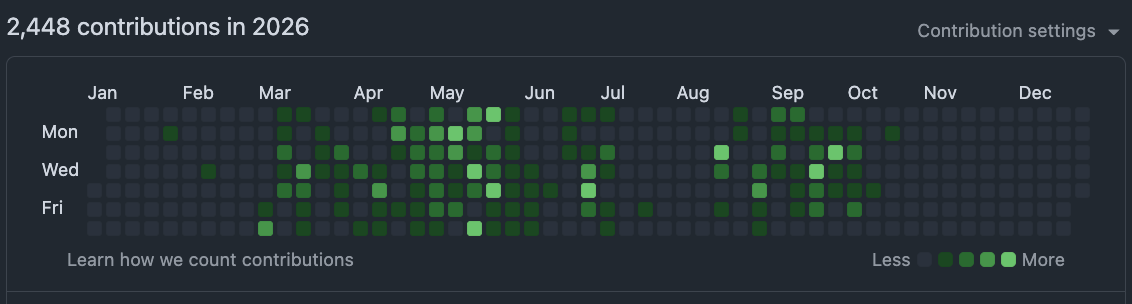
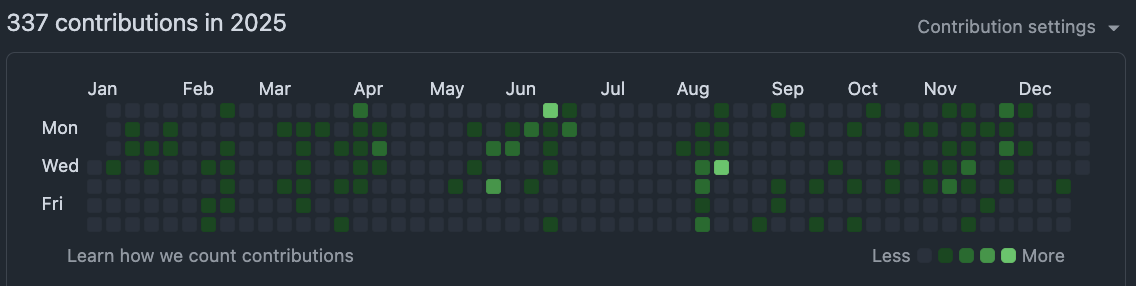
I wasn’t more productive, I wasn’t a better coder, and I wasn’t trying to get more commits.
I’ve been using agentic AI to write code for me in 2026 for projects, classwork where AI is allowed and required, and even for working on this personal website. I don’t think that necessarily means I’m working harder, though.
It’s faster. It has the whole codebase, can make new files, use subagents for delegation, and the speed at which it ships is, well, 7.25x.
You might be wondering why I put the Flash from the animated Justice League show as the title image.
It’s because we are the Flash, Barry.
If you know, you know.
I think it’s a good analogy. When you use AI to write code, the pros are that it’s faster, more efficient, and can operate across much more of the codebase at once. The con is that you need tokens.
Tokens cost money, and they’re not cheap either.
A lot of people can now make products at a ridiculous rate, but you need Codex, Claude, or something similar to help you. The rate at which companies expect you to ship means AI is becoming part of the workflow. It’s weird because when AI first came around, people said to stop using it, and now everyone is demanding it.
The Flash analogy is simple.
When you have tokens, you are the Flash. You are running at full speed, shipping features, fixing bugs, writing tests, doing frontend work, connecting Supabase, and letting AI handle things while you cook your ground chicken.
Then you hit your usage limit.
You become Barry Allen.
Just a regular human being.
And being Barry Allen right now sucks because everyone is paying to be the Flash.
Companies are giving their SWEs token budgets. My school Northeastern University even gives students access to Claude Enterprise.
The analogy isn’t enhanced vs. natural in the gym. It’s that once your workflow is built around AI, losing access to it suddenly makes normal coding feel incredibly slow.
Right now, I was working on Refara, and I’m proud that I finished my first batch of training and that V1 is complete. But I used up my usage and had to wait.
I genuinely didn’t know what to do, so I started writing this blog and went to get a sandwich.
When my AI credits run out, I often just stop coding. Writing lines of code manually is something I’m probably going to say “back in my day” about 20 years from now.
In this case, “you need to spend money to make money” actually makes sense.
AI can produce results at an alarming rate, so manually writing five methods, two algorithms, and a couple of API hooks starts to feel pointless when your competitors are using every AI tool, every automation, and enough subagents to make GTA 6 from scratch before it releases.
Using AI is the norm now, and that’s fine with me.
What’s weird is the uncertainty I feel when my tokens run out.
Do I wait for the reset? Work on something else? Manually code?
The fact that I’m uncomfortable waiting is interesting in itself.
I think this LinkedIn post also helped me realize that this is becoming an actual problem.
Companies care about output, speed, and how much you can ship. Some engineers aren’t even checking every line AI produces because they have to keep moving. When you are generating that much code, it becomes a hassle to inspect everything, verify every assumption, and make sure nothing breaks in future iterations.
The interesting part is that this came from an engineer at Meta.
I need Instagram Reels though, so hopefully they keep the servers running.
But if more engineers are moving toward higher-level work, that means two things: more people can become AI architects, and high-level engineering can also mean becoming more dependent on AI.
Low-level engineering — debugging, writing small pieces of code, manually implementing everything — used to be much more central to the job. Now, for a lot of engineers, it is becoming a smaller part of how they spend their time.
That means many engineers, including myself, are becoming heavily dependent on AI. Without it, everything starts to feel weird because AI-assisted development has become the new normal.
But the interesting thing isn’t really AI itself.
It’s the culture around how fast you are expected to ship.
Token culture.
In SF, people talk about 9-9-6 culture: working from 9 AM to 9 PM, six days a week, constantly trying to ship, deploy models, spend tokens, and do everything possible to build the best AI company.
The pressure isn’t just to work hard anymore. It’s to use every tool available to move faster than everyone else.
I think I already wrote about an earlier version of this in one of my first posts, Invisible Speed.
“Invisible speed” is the pressure created by how quickly AI now lets people build software. Production-grade products can be created faster than ever, which is exciting, but it also makes it feel like if you don’t move quickly, someone else will build your idea first. The catch is that speed alone does not create a successful company. You still need distribution, branding, marketing, and an actual business around the software. So the real problem isn’t just that everyone can build faster; it’s that developers now have to learn how to turn that speed into something people actually care about.
So yes, you still have to build a business around your product.
But there is also this scary feeling that if you don’t work on your idea consistently, someone else will act on it first.
That fear alone increases how much you use AI, how many tokens you burn, and how much pressure you put on yourself to keep moving.
I think the real problem is the culture around it.
A lot of people still don’t know how to react to AI. Some are panicking. Some are using it 24/7. Some are trying to squeeze as much output as possible from every model and every tool.
Just because there is a tool that allows you to be the Flash doesn’t mean you have to be the Flash 24/7.
 A blog post written by Shreyas Shukla
The Stoic Stack, in your inbox.
Get notified when I drop a new post. Software, AI, sports, philosophy, and life — unsubscribe anytime.
More Blogs Like This
I’ma Focus… After One More Reel
The reels are the easiest escape. But what if the real problem is a goal built on fear, rather than something you actually want?
Subagents Might Cook Us
AI’s speed isn’t what concerns me. It’s getting better at delegation and efficiency. So what happens when one agent can manage a whole team?
I Asked AI for More Hot Takes
I pasted the same prompt into GPT three times and graded its philosophical hot takes — on luck and success, finding yourself, and why closure is overrated.