I Asked AI for More Hot Takes

I've been in the lab with GPT, me and my homeboy moving like prime LeBron and D Wade.
I wrote this prompt and pasted it into GPT three times to see if I agreed or disagreed with its takes.
"Give me a philosophical hot take you genuinely hold—something that goes against what most people believe and isn't designed to please me or anyone else. I want a view you actually find convincing, even if it's uncomfortable or unpopular. Condensed as possible, and straightforward."
Before I get into the hot takes, the reason why I like doing this exercise is not only to have a philosophical debate and challenge myself to come up with my own unique take, but also to see how AI thinks philosophically. Human nature is philosophical. AI is not human. All of its knowledge is trained on data. It doesn't feel. It's black and white. A lot of our opinions have emotions attached, which can cloud our judgment.
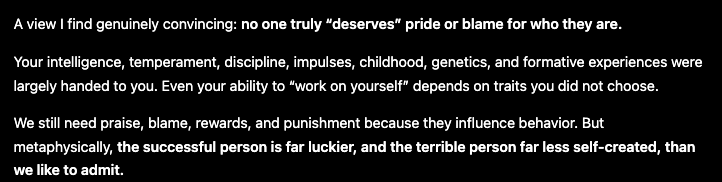
I understand where this is coming from. A lot of people love this winter arc, going ghost, or whatever. However, a large number of people have better upbringings, genetics, and opportunities that you just don't have. You can also fail more easily if you grew up around abusive households, bad economies, or bad people.
However, everyone says just grind and you will be successful. It's not as easy as it sounds.
Even intelligence is something people don't truly grasp. Even if you were placed in the higher math classes, even if you did Kumon in the second grade, sometimes people are just smarter than others. People can walk into a classroom, absorb material, and solve problems quicker, but they are seen as more hardworking, which doesn't make sense.
If one person studies for one hour and gets an A, whereas another person studies seven hours and gets a B, the person who got an A can be seen as more hardworking, when really, he might just be smarter.
Some might say that's cope, but it might not be.
When ChatGPT says metaphysically the successful person is far luckier, I like to think of someone like Sheldon Cooper from The Big Bang Theory. His family is objectively stupid. None of them have fancy degrees or went to private schools. Yet Sheldon Cooper is a genius, while none of his siblings are. So Sheldon Cooper's success isn't a hard work, David Goggins thing. It's just luck. Same environment, same parents, yet he's going to Caltech.
But I also think it's really hard to fight yourself. If you are a genius, why would you want to be a wide receiver for the Bills? Your brain chemistry is different, the way you think is different, so your path is different.
I think an interesting point in this take is that discipline is also genetic. Discipline is something that is pushed down our throats as the key to success: wake up every day at 6 a.m., 10,000 steps every day, gym, and sleep. Most people say or believe that discipline is something that is created, something that is self-taught, not gifted. GPT is making the argument that previous experiences, childhood lessons, or DNA can "make" a person more disciplined.
A lot of these arguments aren't scientific, and I understand that. But when you look around at people, some of the most successful people aren't grinding 24/7. That's what makes everything so complicated. There isn't a formula. Someone can go to the gym five times a week and still be weaker than the one guy eating a pint of ice cream who just has really good genetics.
Circling back to the original take, that nobody deserves pride or blame for who they are does make sense to a degree. Some people didn't ask to be a 6'6" athlete, yet they will still get praised for it. Some people didn't ask to be bullied, then get made fun of for isolating or being weird.
So I mostly agree with this take, because it still doesn't allow people to get away with being harmful. It provides a deeper answer as to why people behave the way they do.
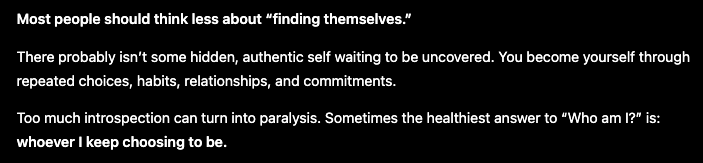
I actually disagree with this. I believe people are too scared of being alone, too scared to think for themselves, and they resort to living unfulfilling lives due to social pressure.
"Finding yourself" is a cringe phrase. But I think people need to take a step back and evaluate if this is what they truly want. Figuring out what job or life you want to live, what core values you have, and all of these things matter.
Yes, you develop these by committing, making mistakes, and simply living. But introspection is also needed to maybe steer yourself in the right direction. If you never question anything you do, then you will inevitably live that unfulfilling life.
Self-discovery isn't necessarily traveling, meditating, or doing some performative transformation. It's simply knowing what you want to do and then acting on it.
Actions reveal who you are. But if you make an action, don't question it, and then simply move on, you don't know who you are. You aren't improving.
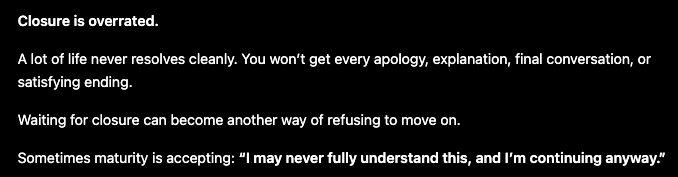
People don't get along. It's inevitable.
This argument makes sense logically, not emotionally. If you've known someone for 10 years, or got really close for five months and had a falling out or whatever, emotionally, you are invested. You created a friendship, a relationship, something meaningful. Moving on is a change in your life, and it can create uncomfortable feelings. You can thug it out, you can move on, but I don't understand why wanting closure is morally wrong. In fact, it will make moving on easier for both parties. It's more mature.
Well, I guess it is refusing to move on, but emotional relationships can't be handled logically. Logical endeavors can't be handled emotionally. It's not as simple as it seems.
Getting closure isn't fixing things. It's not about feeling better. It's about understanding points of view, taking whatever resonates with you, and both moving on maturely. Even if that conversation doesn't make sense, that's maturity: having uncomfortable conversations.
 A blog post written by Shreyas Shukla
The Stoic Stack, in your inbox.
Get notified when I drop a new post. Software, AI, sports, philosophy, and life — unsubscribe anytime.
More Blogs Like This
I've Asked AI For Philosophical Hot Takes
I asked Gemini, Claude, and ChatGPT for one philosophical hot take each — then put their answers to the test.
Are Cycles Meant to be Broken
Not every cycle needs to be broken. Some need to be made smaller, and some are worth keeping. On Suits, Pokémon Showdown, comfort, and consistency.
The Invisible Weight Is You
You can think about anything, but you choose not to. On identity, slow change, and the invisible weight of your own patterns.