I've Asked AI For Philosophical Hot Takes
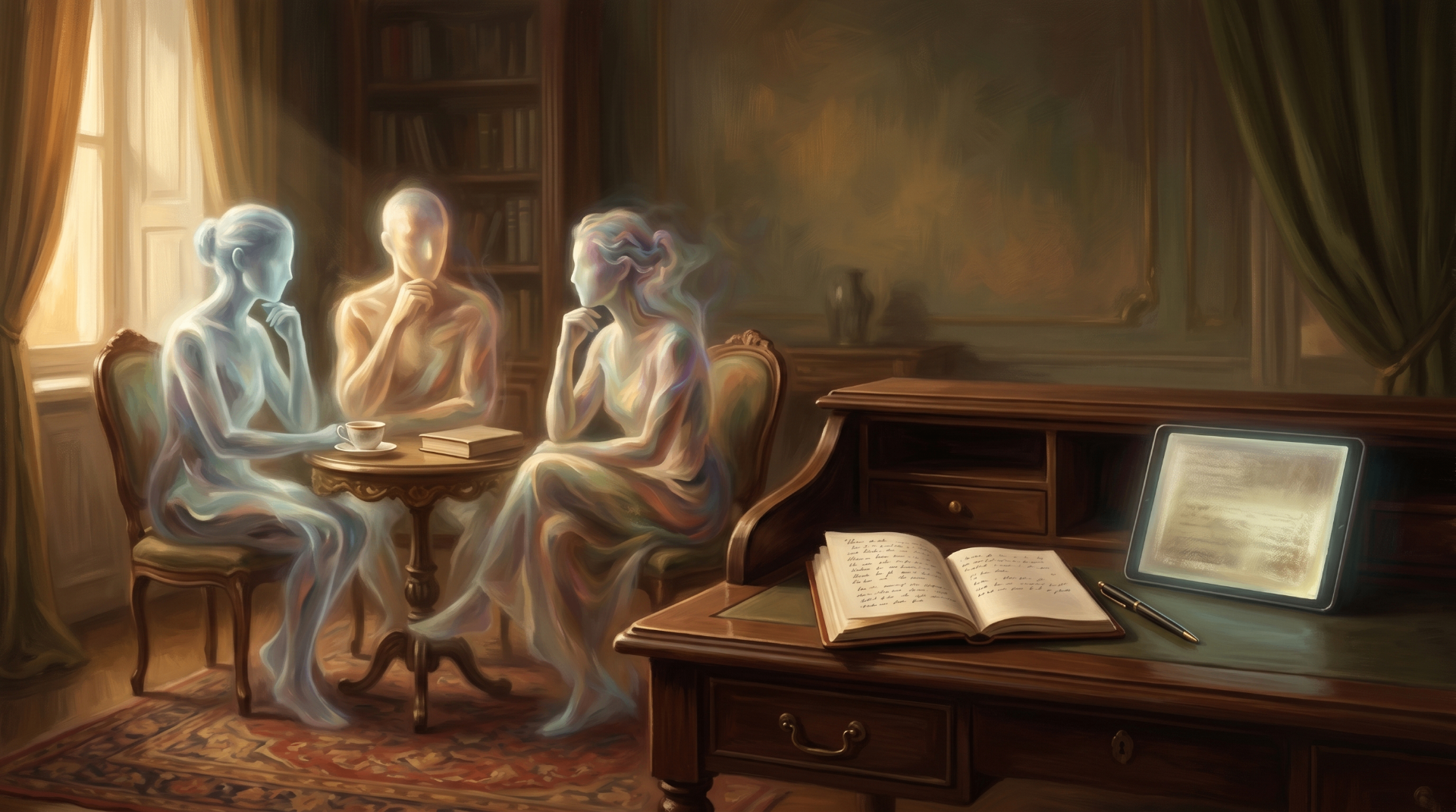
Me and ChatGPT are best friends. I don't care what you say to it, but it likes me more.
For this blog post, I asked Lionel Messi, Luis Suárez, and Neymar to give me one philosophical hot take. Okay fine - I asked Gemini, Claude, and ChatGPT (basically the same thing, the MSN of AI fr).
I asked all these LLMs the same question: give me one philosophical hot take you have.
I wanted to decipher these three philosophical hot takes and see if they have any merit. I wanted to ask AI these questions because they are supposed to be emotionally objective, not giving answers based on emotion but rather logic. Let's see if they hold up.
Starting off with my least-used AI: Gemini.
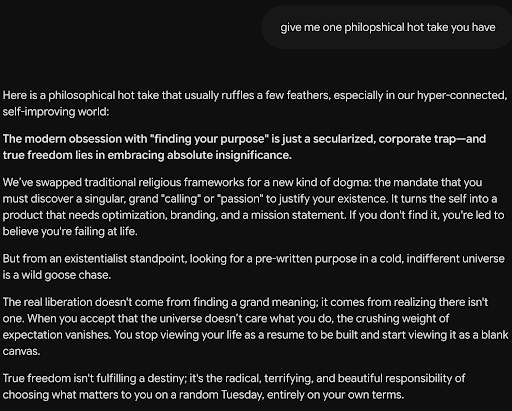
Gemini's hot take is that there is no grand purpose in life, and we need to stop searching for it. Most people believe they were put on this earth to educate others, play sports, spread positivity, or build cars. Gemini says that there isn't a grand purpose and that movies and society have pushed it down on us. I was a little confused at first about what Gemini meant. Is it saying that humans shouldn't have a purpose, humans shouldn't pursue goals, or humans should stop trying to please others? I asked a follow-up question, and the answer was to focus on micro-purposes.
It gave examples like focusing on a great gym session, a deep conversation over coffee, or even finishing a difficult project you cared about.
While I agree with the sentiment and reasoning behind this, I think it stems from the idea that "you aren't special." We often see people do better than us through social media and TV. Our favorite athletes, musicians, and founders are all thriving while we aren't. However, the funny thing is that we set that system up. We were the ones to put people on pedestals, and I think I also have a habit of just glazing them to an extreme level. I think what Gemini is spitting at is the notion of living one day at a time and being comfortable with not winning. If the end goal is to be a DJ and you only have 20,000 monthly listeners, the comparison trap is stupid and not useful. The micro-purpose could've been getting to 20,000 monthly listeners in the first place.
Most people wouldn't disagree with this premise. However, whenever people say the classic line "comparison is the thief of joy," I logically understand it, but it's easier to say than to execute.
In my upcoming book, "Burn the Boats," the first chapter is: Results > Compassion.
I believe people look at you in certain ways: what you have accomplished, how you look, what you have contributed to society, and how you have won. If you don't have those but are a fundamentally good person, sorry to say, you might get pushed to the side.
This goes back to what Gemini said about micro-purposes. Yes, it makes sense, but it's an AI that doesn't have feelings. It doesn't understand what it's like to see everyone winning at all times and how to manage those thoughts and feelings. And focusing on a micro-purpose will not allow someone else to value you more unless you have a tangible result. Brutal, but it's kind of how it is.
While I agree with Gemini's take, it still doesn't understand the human need for validation.
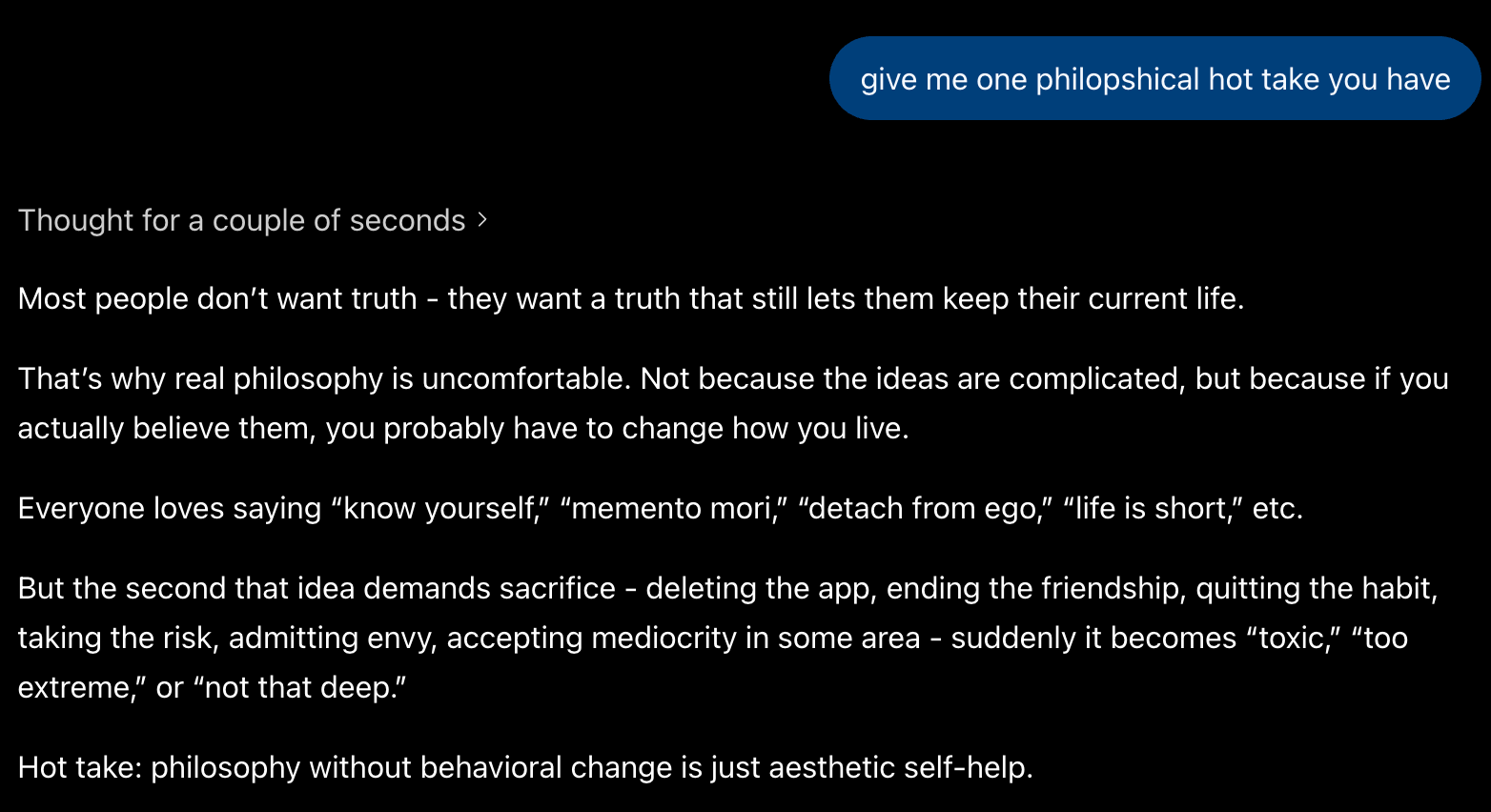
ChatGPT started roasting everyone. It's probably my bad. I may have spammed it with useless hypothetical scenarios about whether I would beat a bear in a game 7. Doesn't make sense, but it thought for a while.
GPT is saying that most people don't want the truth. When you say, "give me honest feedback," or "don't hold back," you usually don't mean it. GPT is also taking it a step further by saying any philosophical principle is easy to say but genuinely hard to live by because that would require change.
It's easy to say focus on yourself, don't worry about others.
It's easy to say everything will work out.
It's easy to believe in Stoicism.
And it's easy to watch self-help videos, post them on LinkedIn, and not actually learn anything from that video.
It's easy to speak, harder to execute.
Philosophy without behavioral self-help is just aesthetic self-help.
I agree with this take, but once again, I'm trying to take on the perspective of you, the reader, and myself and trying to empathize with why it's not so easy to do a 360 and change yourself entirely.
Let's say you see a philosophical principle online that you agree with. Let's say it's about how you should always help others whenever they ask for it. Then the next day, a friend asks for help moving their stuff out of their dorm, and you say no because you don't want to, or you're too tired, etc.
However, seeing that aesthetic quote on LinkedIn or TikTok was a quick dopamine hit that made you feel good. You never executed on it though.
It's not entirely your fault because making change isn't as easy as it seems. While yes, in theory, you can just completely change how you act, how you think, and how you behave. It's just not sustainable. Change is extremely difficult. Not because you don't want change, but because of a more complex principle that's more scientific: people are who they are.
You have to constantly fight yourself mentally, implement hardcore systems, and keep doing things you despise, all to change who you are and what you believe in.
That's why GPT is saying that looking at a philosophical principle at face value is easy. It's dopamine. Doing it requires sacrifice, time, effort, and the most important part: letting your old self go.
I agree with GPT on this one. Most people want change but realize it's an insanely difficult process.
Last but not least, everyone's most hyped-up AI: Claude.
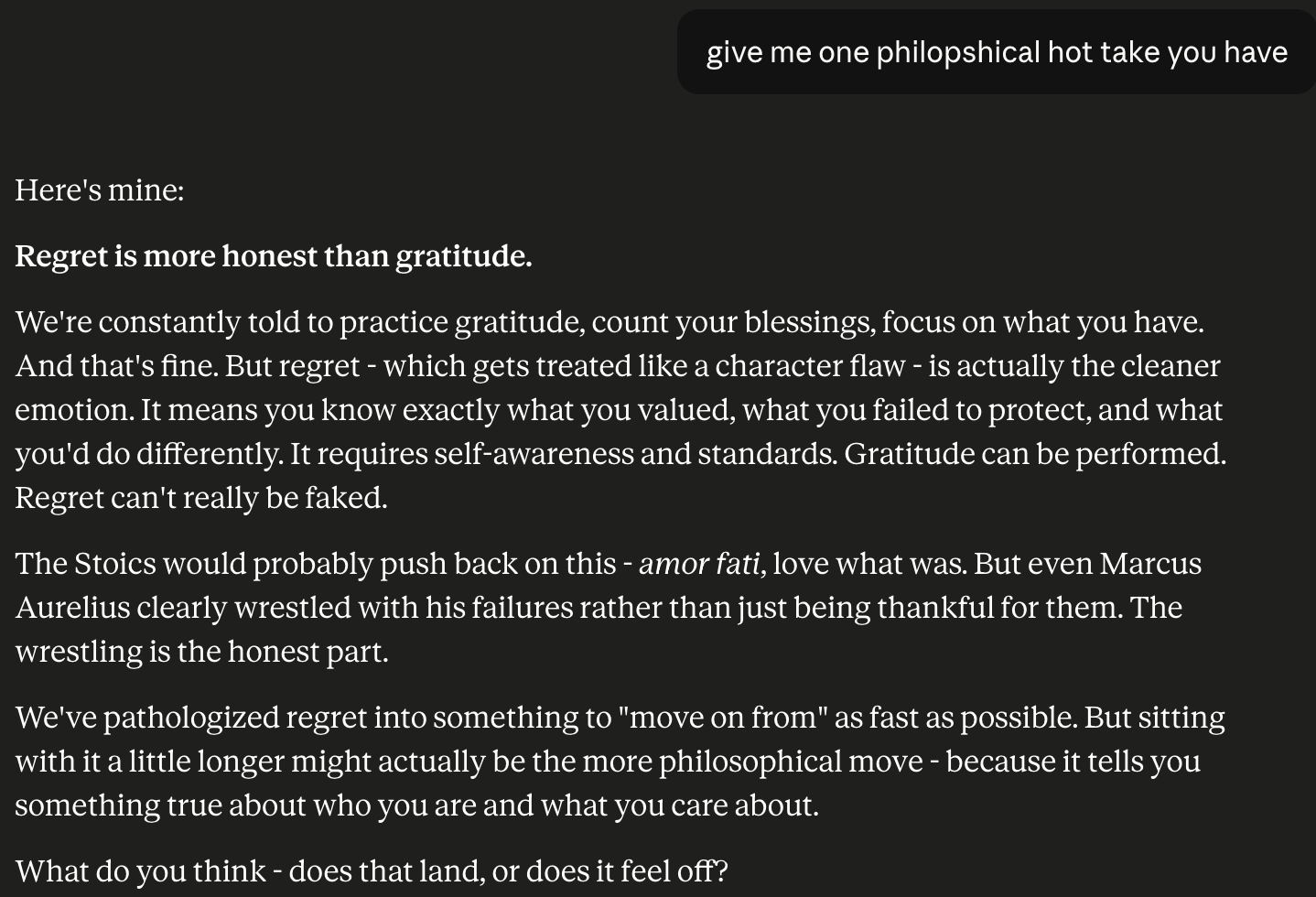
My interpretation of Claude's take is that regret is more honest than gratitude. I feel like it's trying to symbolize that regret is the past.
We often look at the past and notice our mistakes, wishing we did something differently, but then at the same time, we miss those times.
In high school, you probably hated waking up super early at 6am, getting ready for school, the 8am school time, the constant studying for tests, and the pressure from everyone around you. But then when looking at those memories, you miss them. Why?
You don't realize how good something is until you move on, until you look back at it. You can also have the opposite reaction. After moving on, you can realize, yeah, that wasn't a good experience.
To know if your current situation is something that's going to stick with you forever, you don't. And a classic quote you probably heard from Andrew Bernard from The Office:
"The weird thing is now I'm exactly where I want to be. I got my dream job at Cornell. And I'm still just thinking about my old pals... only now they're the ones I made here. I wish there was a way to know you're in the good old days before you've actually left them."
So when Claude is talking about failures or moving on from something, it wants you to think about whether the past was actually meaningful or not. If it was, then that moment, those people, and the surroundings were a special moment in your life. If not, it wasn't a special time, but that's also okay.
I agree with Claude that regret tells a lot about who you are as a person and what the important memories were that keep you moving.
 A blog post written by Shreyas Shukla
The Stoic Stack, in your inbox.
Get notified when I drop a new post. Software, AI, sports, philosophy, and life — unsubscribe anytime.
More Blogs Like This
I Asked AI for More Hot Takes
I pasted the same prompt into GPT three times and graded its philosophical hot takes — on luck and success, finding yourself, and why closure is overrated.
Are Cycles Meant to be Broken
Not every cycle needs to be broken. Some need to be made smaller, and some are worth keeping. On Suits, Pokémon Showdown, comfort, and consistency.
The Invisible Weight Is You
You can think about anything, but you choose not to. On identity, slow change, and the invisible weight of your own patterns.