Is Diogenes Goated?

On my birthday, I graduated from Khoury College of Computer Sciences and then had philosophical debates with my family. My brother said the words "Diogenes is goated." I had no idea what that meant, so let me try to break it down for you because I did my research 🥱
The reason why I personally struggle with a lot of philosophical ideas is that sometimes the ideas don't hold up in current-day situations. That's why I love Marcus Aurelius, Meditations, and Stoicism, because it is relevant to current-day life.
Right now, the job market is cooked, the future is unknown, and nobody knows what's going to happen. Stoicism allows us to do the work and realize that external factors aren't in our control. The only things in our control are our own mind, body, and actions.
I'm going to dissect three of Diogenes' quotes, conversations, and philosophical ideas to come to a conclusion on whether Diogenes' ideas can actually be used today, tomorrow, or when you're connecting with that one cracked guy who worked at SpaceX and Nvidia.
First, Diogenes was a Cynic, meaning the pursuit of truth was the be-all and end-all. Nothing else mattered. He rejected wealth, status, social approval, and fake manners. He lived extremely simply and used jokes, public stunts, and blunt insults to expose how artificial society was.
1. Alexander the Great story
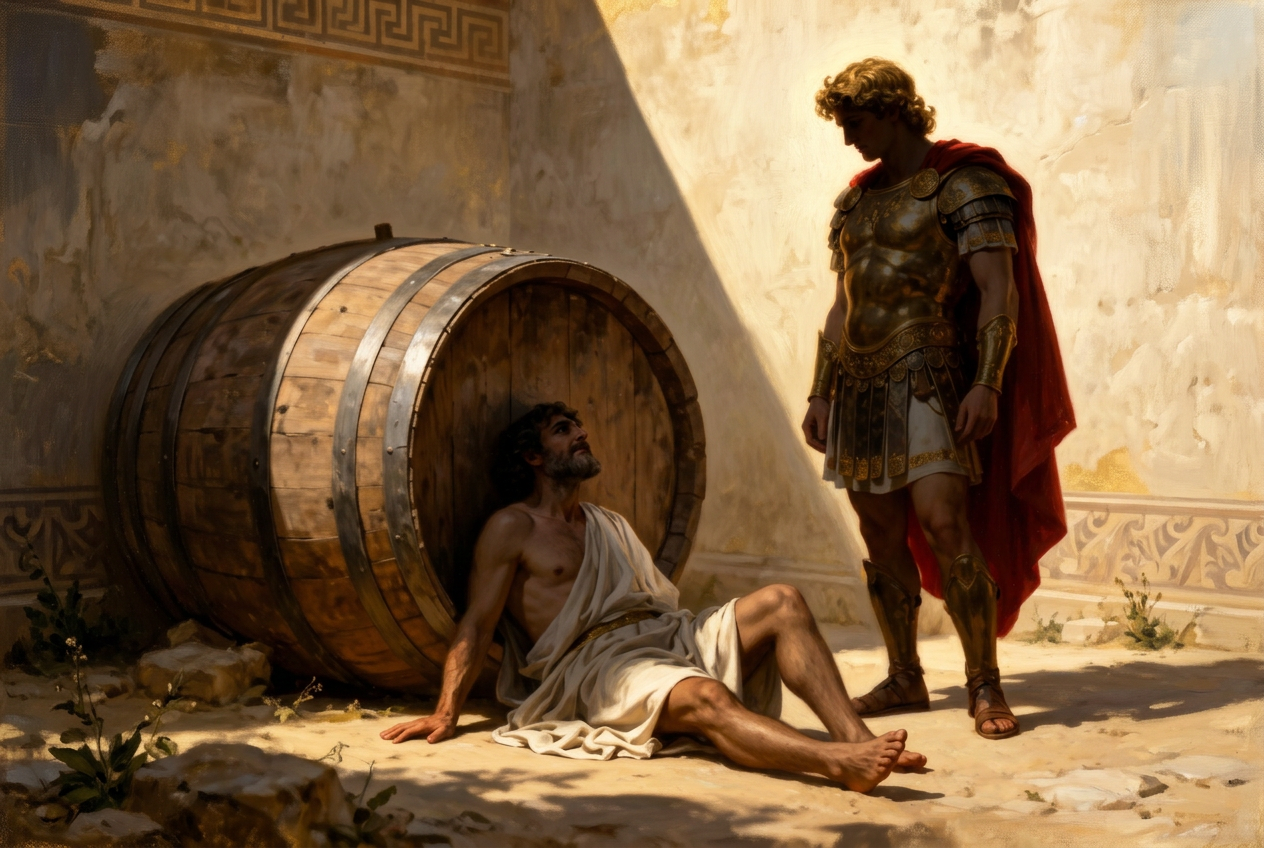
Alexander, literally the most powerful man alive, visits Diogenes and says something like, "Ask me for anything."
Diogenes is chilling in the sun and replies, "Move. You're blocking my sunlight."
Diogenes is basically Sung Jin-Woo.
But on a more serious note, while this is a nonchalant approach to life, there is some merit to it. Alexander the Great was an amazing leader that everyone looked up to. For Diogenes to brush him off might make him seem like he's trying too hard to be different. I think it teaches us: (1) not to put people on a pedestal, and (2) not to be attached to anything.
A lot of us put celebrities on pedestals just because they accomplished one thing and it makes them "deserve" all the praise and hype. I love Travis Scott, Erling Haaland, Jayson Tatum, and even Tom Holland. But do they deserve to be put on pedestals, get more respect, and receive endless glaze? People with more status, more money, and more everything shouldn't be viewed as profound, god-like figures. Supporting them and appreciating them is one thing, but going crazy over them doesn't make sense. Why should they be put on a pedestal? At the end of the day, we all bleed the same, and the desperation of valuing and wanting things from other "successful" people is a waste of energy. You become a slave to other people.
2. The lantern story
Diogenes walked around in daylight with a lamp saying he was "looking for a man," often modernized as "looking for an honest man."
The point was not that he literally needed light. He was saying that people are zombies, mindlessly walking around trying to compete with one another with no morals or values. Do you genuinely want to study your major, genuinely like the music you listen to, or even like the food you eat? Is your behavior coming from your own intuitive thoughts, or is someone brainwashing you through social media or in class?
Do people genuinely live for themselves, sticking with their own morals, or do they just copy the people around them to feel valued by society? It's hard to tell, but Diogenes is telling us to figure out who you truly are and unapologetically live your life. Don't be a Minecraft zombie fr.
3. Living in a jar/barrel
People say he lived in a barrel, but it was more likely a large ceramic jar, called a pithos.
The point was not "homeless man aesthetic." It was: why spend your life chasing luxury when you can train yourself to need almost nothing?
Why do you need a Porsche 911 when you can have a Toyota? Why do you need a Rolex when you have a phone with the time on it? Detachment is what Diogenes is proposing. You don't need anything except shelter, food, water, and a purpose. A lot of the things we have are nice additions to life, but they aren't required to function.
They create artificial happiness. For two hours, you are happy partying with a bottle on a boat, and then you realize you don't have a meaningful life. I think Diogenes represents a detached lifestyle by suggesting that besides survival utilities, comfort and status don't create happiness.
Again, this might be an extreme scenario - living in a barrel - but trying to live your life for a paycheck or for a car will not result in a happier life. And if you can live without these things, wouldn't that be better? Because you aren't pursuing things to impress other people.
My final takeaway on Diogenes is that he did have meaningful takeaways. Even though he might be portrayed as a troll philosopher, he has philosophical concepts that we can implement. I do think his views are extreme, though. For example, you can still like celebrities, like common hobbies, and even have a luxurious house. You just need to understand the law of detachment and have an internal reasoning that none of these truly matters. The less you have, the happier you become, and the less of a people pleaser you are.
 A blog post written by Shreyas Shukla
The Stoic Stack, in your inbox.
Get notified when I drop a new post. Software, AI, sports, philosophy, and life — unsubscribe anytime.
More Blogs Like This
Are Cycles Meant to be Broken
Not every cycle needs to be broken. Some need to be made smaller, and some are worth keeping. On Suits, Pokémon Showdown, comfort, and consistency.
Phil Foden Confuses Me
Would you rather consistently be a 7/10, or reach greatness and struggle to access it again? On Phil Foden, zigzag growth, and consistency as a talent.
The Invisible Weight Is You
You can think about anything, but you choose not to. On identity, slow change, and the invisible weight of your own patterns.