Jake the Dog and Rigby Figured Life Out
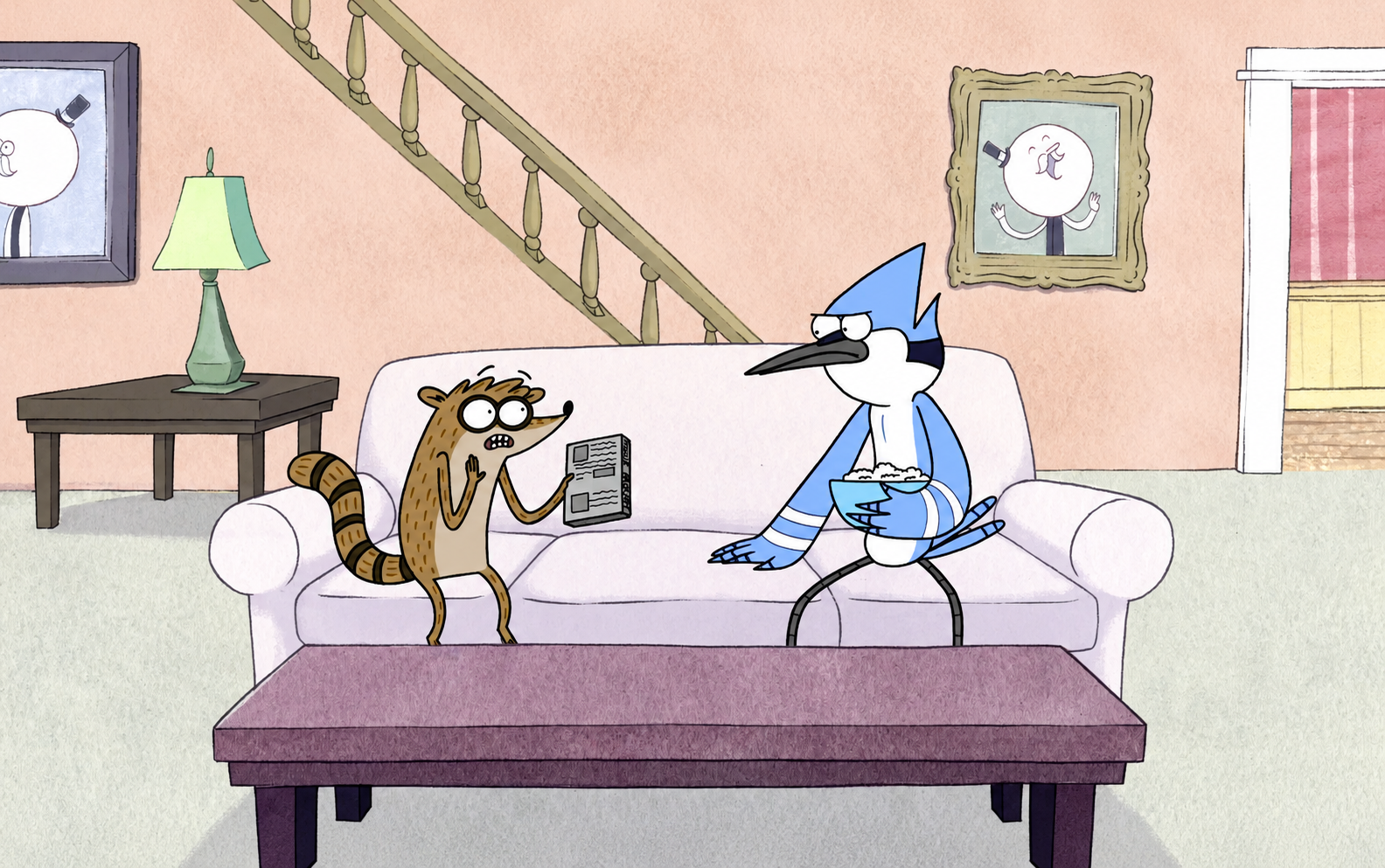
I've been thinking about Jake the Dog and Rigby from Adventure Time and Regular Show, and I think they might have life figured out more than Finn and Mordecai.
Which sounds stupid because Jake and Rigby are both reckless, lazy, impulsive, and unserious. Jake will ignore cosmic stakes for lunch, and Rigby has made some of the worst decisions in cartoon history. These are not exactly people you would trust to file your taxes or give you a five-year career plan.
But somehow, they seem happier. That's the part that confuses me.
Finn and Mordecai are technically the more responsible main characters. Finn wants to be a hero. Mordecai wants to be mature, artistic, and emotionally deep. They both think a lot. They care about doing the right thing. They want love, purpose, and meaning. But because of that, they are constantly suffering. Jake and Rigby are just kind of there. And maybe that's why they win.
Finn constantly obsesses over Princess Bubblegum, and it's painful to watch. I feel like the guy in Interstellar trying to tell his past self not to leave, except I'd be telling my past self not to go down the path of putting other people on a pedestal. Finn isn't just liking someone. He is building an entire reality in his head around her. Every interaction means something. Every small moment becomes a sign. Every possibility becomes a fantasy. That is not love, it's obsession. You lose yourself in the process, chasing validation.
Finn is a genuinely kind-hearted person-his intentions are pure. He's brave, loyal, caring, and heroic. However, he quite literally treats her like a princess, but at the end of the day, she's just another person. He forces things and doesn't allow them to flow-to happen naturally.
Mordecai is the exact same way. Instead, he's an insane overthinker. Battling me in second.
Mordecai is always trying to figure out romance, adulthood, maturity, and who he's supposed to be. He likes Margaret, then CJ, then he gets stuck in his own emotional indecision.
He overthinks everything. He wants to be a good guy, but he also keeps making situations worse because he can't just be honest with himself. Mordecai is what happens when you are self-aware but not brave enough to act clearly. That is why he is frustrated. He knows enough to understand that something is wrong, but not enough to stop doing it. He wants love, but he also wants comfort.
He wants maturity, but he still avoids uncomfortable choices. He wants to grow, but only if growth doesn't force him to lose anything. But like Finn, he doesn't have self-respect and will keep holding on to an impossible relationship with Margaret even though she doesn't give clear signals.
And then you have Rigby.
Rigby is not trying to find love. He is not trying to become some deep, emotionally evolved version of himself. He is not sitting there journaling about whether he is ready for a relationship. He is just being Rigby. And somehow, he finds love anyway.
Rigby is always trying to have fun, randomly playing the new video game shown on TV, trying to beat an egg challenge, or escaping from the Master Prank Caller. You kinda have to watch the show to know what I'm talking about. Rigby is reckless, but he is not trapped inside his own head the way Mordecai is. Jake is the same.
Jake is probably one of the wisest dumb characters ever written.
He gives terrible advice and amazing advice at the same time. He is lazy, unserious, obsessed with food, and constantly doing random nonsense. But he also understands life in a way Finn doesn't. Finn is always trying to be heroic. Jake is just trying to live.
The ultimate example is when Jake meets Prismo the Wishmaster. Finn is trapped in an alternate, dangerous reality and desperately needs saving. Reality is broken. His best friend needs help. Any normal hero would lock in.
Jake's first instinct is to use his reality-warping wish to get a sandwich.
That is insane. I would use my wish to undo the Jaylen Brown trade or to become Batman.
Prismo has to step in, make him a sandwich from scratch, and give him a jar of pickles so Jake doesn't waste one of the most powerful wishes in the universe on lunch. But chicken quesadillas do be goated, so I can't complain there.
Living in the moment is one thing, but it's extreme in the sense that he doesn't even realize what's happening in the world around him. He's too focused on whatever urge he has, but his intent isn't wrong. It's not that he doesn't want to save Finn-course he does. His mind is one-dimensional; it can't process multilayered problem-solving tasks like trying to save Finn in an alternate universe. The boy gotta hit his macros.
That sounds stupid, but maybe that's why Jake survives life better. Some people are so obsessed with doing the right thing, becoming the right person, finding the right relationship, making the right decision, and chasing the right future that they forget how to exist.
That is what Finn and Mordecai struggle with. They are always chasing something. Finn chases heroism, love, identity, and destiny. Mordecai chases romance, maturity, and some ideal version of adulthood. They want answers so badly that they become anxious.
Jake and Rigby don't really chase answers. They trust their instincts-the first thought = best thought approach.
But the most annoying thing about Finn and Mordecai is that their intentions aren't wrong. Their morality is just, and the effort is admirable. They want love, respect, and validation. Wanting those things isn't inherently wrong because all humans want them in their lives.
What confuses me about Mordecai and Finn is that they are both introspective and prospective at the same time. Finn wants Princess Bubblegum, and then internally tries to figure out how to get her. Mordecai wants Margaret, and then does the exact same thing.
Jake and Rigby are neither. They are neitherospective. Okay fine, it's called being present-oriented.
A present-oriented person focuses mainly on what is happening now rather than dwelling on the past or planning extensively for the future. Psychologist Philip Zimbardo's Time Perspective Theory describes present-oriented people as giving greater weight to immediate experiences, emotions, and circumstances. This can encourage spontaneity and living in the moment, though taken too far, it can also mean ignoring lessons from the past or consequences in the future.
A hyper-present-oriented lifestyle seems unsustainable.
I am hungry-I'ma get Five Guys.
I am bored. Let me play COD.
I am tired, so let me binge-watch HIMYM.
Turns out, tomorrow you have the MCAT and you never studied.
But this doesn't make sense because Jake and Rigby are balling.
I believe a hyper-present-oriented lifestyle shouldn't work on paper, but it does because our society is built around rules, timelines, and glorified achievements that, when you really think about them, don't always mean much. Being hyper-present-oriented shows that a lot of the things you think you want, worry about, or reminisce about are probably not as worthwhile as you make them out to be.
Hypothetically, when life was more about survival and less about timelines and objectives to hit, being introspective and prospective was probably the cheat code. While other people were goofing off, the people who locked in tended to live better lives. But now, I think it might be the opposite.
So let's try to be Jake the Dog and Rigby, but please use your one wish on Travis dropping a new album.
 A blog post written by Shreyas Shukla
The Stoic Stack, in your inbox.
Get notified when I drop a new post. Software, AI, sports, philosophy, and life — unsubscribe anytime.
More Blogs Like This
Are Cycles Meant to be Broken
Not every cycle needs to be broken. Some need to be made smaller, and some are worth keeping. On Suits, Pokémon Showdown, comfort, and consistency.
The Invisible Weight Is You
You can think about anything, but you choose not to. On identity, slow change, and the invisible weight of your own patterns.
You Remember the Detours
The milestones are meant to define us. So why do we remember the detours? On uncertainty, peace, and learning to trust your instincts.